Does having to show how injustice affects “you” indicate a general lack of morality?

Sometimes in order to get people to act against an injustice, one needs to demonstrate how it affects them personally. I’m not talking about “what if something similar happened to you”, I’m talking about “you’ll really feel the effects of the war when petrol prices go up”.

It’s not usually something as trivial as petrol prices. You might have to say things like “the invasian of Iraq will fuel hatred and aggrevate would-be terrorists” indicating that it will ultimately make life less safe (rather than asserting that invading and occupying another country is simply wrong). Or maybe “intensive farming methods could result in contamination of our food supply” (rather than asserting that animals should not have to endure such appalling living conditions). It seems that we are more easily swayed by arguments that something is impractical or unwise, rather than simply unethical.

It’s selfish and prejudiced to make a moral decision based on how it affects you. You also shouldn’t assume an alterior motive when someone makes a moral argument (in order to deride the argument as self-serving). Arguments should be judged on their own merit, not by what someone wants to get out of it.

Are we really so immoral that injustice needs to have clear negative implications for us before we do anything about it?

On the other hand, is scare-mongering (rather than presenting an argument based on ethics) offensive to our potential for moral character?

Wikipedia corrections in motion

Wikipedia is “the free encyclopedia that anyone can edit“. As a result, it has at times come under pretty heavy criticism for being very subjective compared to traditional encyclopedias. To counter this argument, many Wikipedia die-hards assert that opinions and inappropriate content are quickly removed.

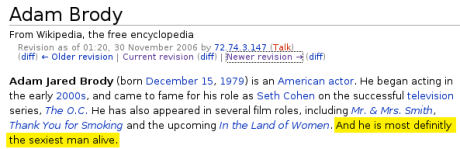
I’ve collected here a few screenshots, links, and fake quotations (my guess as to the thought process behind various Wikipedia contributions) illustrating the introduction and subsequent removal of casual subjectivity on a Wikipedia article.

adam_brody_0.png

Hmmm. I’ll add my personal opinion to this article… is that wrong? I know I’ll add a smilie so that people aren’t offended.

adam_brody_1.png>

What’s with that smilie? How immature. I’ll fix this article up!… that’s how you spell definitely right?

adam_brody_2.png

What the hell is that?! Stupid immature people screwing around with my Wikipedia! If this happens again, I’ll block their asses!

So it seems that for every person who wants to write “OMG! He is so totally awesome!” on the Wikipedia page of their favourite celebrity, there is some finger-wagger waiting to pounce! Let’s hear it for the finger-waggers! (Seriously)

“Spider” video game development

A number of the members of OneTwenty are working on a simple video game entry for next year’s Nullarbor Demo Party and Game Development Competition (which we are also helping to organise). Minh recently made a Call to Arms on her new blog.

The game is (tentatively) called “Spider” and will be a simple 2D game in which you control a spider, keeping it alive (hopefully) long enough for it to reproduce. The design document is pretty (okay, very) sparse at the moment. I have to send Minh the drawings I made for the Nullarbor Mixer last month.

Here’s a spider video for inspiration. It explains the effects of various drugs on the types of webs that spiders make… and it’s very insightful. This phenomenon is detailed on the Wikipedia spider web page. Photos of various webs are available here.

Video found via reddit.

Experimental cuisine

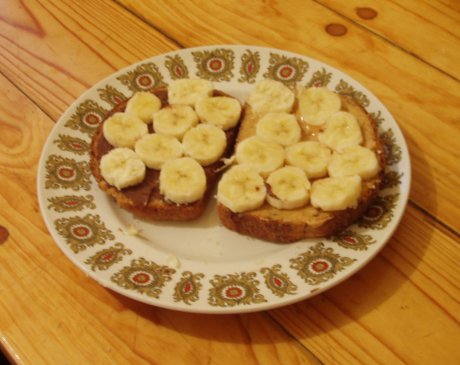
This is kind of a followup to my quick Peanut butter, banana, and Nutella sandwich post. Those who know me well would know that I like to experiment with food. Not in a creepy smother-spagetti-over-my-body-like-that-guy-on-Jerry-Springer sort of way though; I like trying to come up with new recipes. It can be pretty hit or miss… with a lot of misses.

Here’s a quick recap of a few prior experiments. I’m sure there are more, but I can’t think of them at the moment.

Deep-fried jok balls

Day-old jok (Thai congee, savoury rice porridge) that has been kept in the fridge is incredibly gelatinous. So much so that I figured I could roll it into balls, coat these balls with flour, and deep fry them… and that’s what I did. It turned out very well (taste-wise, probably not health-wise).

When eating jok I usually add soy sauce, deep-fried red onion, and vinegar chilli. This makes a great dipping sauce for jok balls! Conclusion: Victory!

Frozen spider

Probably more often called a float, a spider consists of a soft-drink (normally Coke) and a scoop of vanilla ice-cream. When mixed together, the result is a sweet, bubbly, opaque, milky masterpiece of dessert beverageness. Like many other things, I wondered if it could be improved by freezing. Apparantly not.

The ice-cream seems to suck all the flavour out of the soft-drink and leaves a layer of water which then becomes ice. So you end up with: ice-cream, ice, super-sweet pockets of syrup. Mixing the drink furiously before freezing helps a bit, but I don’t really like the well-mixed spider. Conclusion: Failure…

Spaghetti pie

Everyone know that spaghetti jaffles (toasted sandwiches) are the bomb. Jaffles are really like little pies with bread as pastry. So, what about a spaghetti pie? Short answer: it’s great! Conclusion: Victory!

Update: Clearly the use of the word “cuisine” in the post title is tenuous at best!

The true cost of a lowest price guarantee

It seems to me that when most people shop for everyday items, the primary discerning factor (on whether to buy a particular item) is price. People will overlook poor service, questionable supply (“it fell of the back of a truck”), and pretty much anything else in order to get the best price. Is this necessary? Is this wise?

Is it necessary?

For some people, every dollar counts and they simply do not have the luxury of spending more money. For most people I know, this is absolutely not the case. Life for most people in Australia is pretty good; and my immediate peer group is fairly affluent.

There is little reason to spend 20c less on a carton of milk; particularly when you may spend $15 eating out or $30 on a CD you won’t really listen to. You don’t need to shop around. Curbing those “impulse buys” (that later just gather dust) can most likely more than compensate.

Is it wise?

In order to provide the lowest price, a number of other areas have to be sacrificed; not just at the retail store, but all the way through the manufacturer and supply chain. If this chain reflects whatever is required to deliver the lowest price, everything else comes second: service, wages, job security, the environment, … everything else.

When buying something from a store you are communicating that they have their priorities in order to secure your business. Don’t tell them that you can live with poor service and socio-economic problems (resulting from extensive use of cheap overseas labour) provided they can keep the price down. That’s exactly what you’ll get.

What world do you want to pay for?

It’s not all doom and gloom. For many people, price is no longer the main consideration in some areas. For example, many people buy free range (or RSPCA approved) eggs, and reuseable green bags (instead of using free plastic bags). I’d encourage people to add more to that list: recycled toilet paper, phosphate free washing powder, etc.

It’s a matter of deciding what is important to you and working towards that goal. Buying something from a store isn’t just an economic exchange; it’s participation in directing how business is run.

Relationship advice from VideoJug

VideoJug has a growing section of parodic how-to videos on relationships. They offer a mix of humour and serious (?) advice, and are very, very British.

I found their guide on How to be the Perfect Girlfriend via Reddit. (I think the text or audio is from a BBC1 radio broadcast):


VideoJug: How to be the Perfect Girlfriend

Here’s the complementary video on How to be the Perfect Boyfriend:


VideoJug: How To Be The Perfect Boyfriend

I wonder how long before these humourous videos outnumber the more serious how-to videos.

“What luck for rulers that men do not think.”

Today I received two interesting bits of information. The first was a response to the email I wrote to the the Prime Minister concerning the National School Chaplaincy Programme (I’ll post more about that later). The second was a quote that I received via my RSS subscription to The Quotations Page:

What luck for rulers that men do not think.

This quote from Adolf Hitler seems to identify why the Nazis were able to take power in 1933. It also succinctly explains why so much insane legislation makes it though parliament without public outcry. People seem predisposed to intellectual and ethical complacency.

Other quotes that have struck me recently include:

Everyone thinks of changing the world, but no one thinks of changing himself.

by Leo Tolstoy and:

If a man will begin with certainties, he shall end in doubts; but if he will be content to begin with doubts he shall end in certainties.

by Sir Francis Bacon (not to be confused with Francis Bacon the modern artist). Anyone else have some favourites they’d like to share?

Note: I wish these quotes didn’t use such gender-specific language.

I want to play games

It seems that many game developers and old school gamers don’t actually play games. Miyamoto says that he prefers to spend time in the garden, playing guitar, or walking his pet dog. Jaded gamers spend hours reading about games, but don’t really play them much anymore. Me? I love my wii and there are a number of games (across all major platforms) that I have enjoyed recently.

I’m considering a move into the video games industry, but I’m a little concerned that it may diminish my love for games. It seems that the game developer life-cycle goes something like:

  1. Get really into games; play them all the time
  2. Decide to make games; work hard to get into the industry
  3. Make games; work hard to produce a new title every few years

The thing that concerns me is that after the first stage, there seems to be very little time to actually play games. It makes me ask a number of questions: Does making games take away the mystique (such that one is happy to make games rather than play them)? Is game development what I want to do (especially if it takes away from my enjoyment of games)? Are developers mostly inspired by games that they loved many years ago (and can they make truly innovative games in that case)?

I don’t want to spend all my time making games if it means that I become disinterested in them, or if I don’t have time to play them, or if I get so far removed that my games are stuck with outdated notions of gameplay. However, I do want to make games… I suppose I just have to be sure that I always have time to sit down and enjoy them!

High Noon

From the greatest western of all time. From the greatest theme song of all time

Do not forsake me,
Oh my darlin’
On this, our weddin’ day.
Do not forsake me,
Oh my darlin’
Wait,
Wait Along.

Man, that song has been stuck in my head for the last few days! Ever since Heidi gave me a cowboy outfit that she bought from the Sheplers online store. It arrived just in time for Christmas (something Heidi was absolutely chuffed about) and generally fit. The boots, belt, and hat fit well, but the shirt and jeans were a little too large.

highnoon.jpg

Whereas I may not look like Gary Cooper from High Noon (pictured above), I reckon a cowboy outfit suits me well enough. Unfortunately it’s been a little too hot recently to wear jeans and boots. I wore everything on the plane back from Karratha, but soon changed into something more appropriate for the climate (shorts and flip-flops).

Image above from Ashleys.net.

Continue reading “High Noon”